August 2026
War and art: what conflicts left behind in our interiors
Naval battle paintings, commemorative bronzes, Empire furniture: how three centuries of war shaped the objects we collect.
There is a stubborn irony in the antiques trade: many of the objects we love for their gentleness — the patina of wood, the light of a canvas — were born in times of violence. War funds, commissions, destroys and displaces. Whether we like it or not, it is one of the main engines in the history of taste.
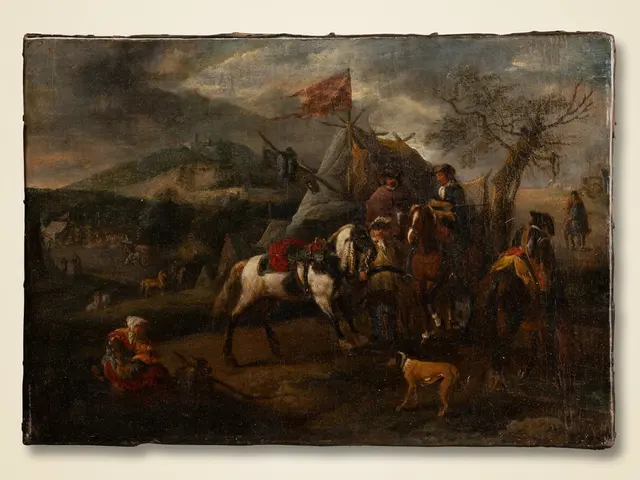
The naval battle painting is the clearest example. In the 17th and 18th centuries, maritime powers commissioned combat canvases much as companies commission annual reports today: to document a victory, flatter an admiral, persuade a parliament to fund a fleet. The painter was a reporter before he was an artist. He was asked for accuracy of rigging, the number of gunports, the direction of the wind. That is why these paintings, often bought for their atmosphere, remain remarkably precise technical documents.
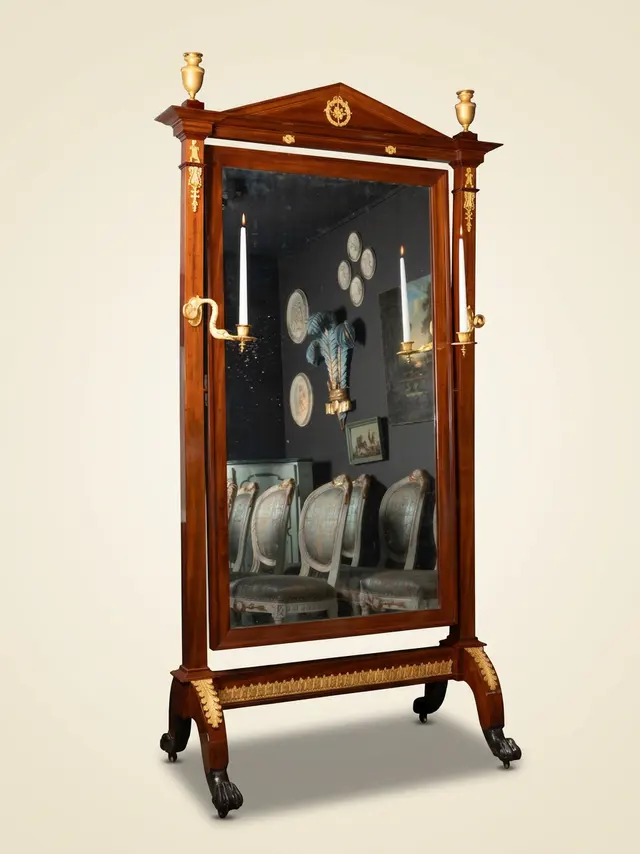
The Empire style tells the same story in furniture. After the Egyptian and Italian campaigns, the decorative vocabulary became militarised: sphinxes, palmettes, lictors' fasces, bees, eagles, gilt bronze trophies. An Empire secretaire is not only an elegant piece of furniture, it is domestic propaganda. Power staged itself in the drawing room before it did so in the street.
The wars of the 19th and 20th centuries then produced an entire category of commemorative objects: soldier bronzes, regimental plaques, officers' mess silver, cups engraved with battle dates. Part of that production is mediocre and sentimental; the rest, from serious foundries, reaches a quality of chasing rarely found after 1945. Buying such pieces means separating emotion from material.
We must also speak of what war erased or moved. The bombardments of 1914-1918 and 1940-1945 destroyed entire interiors, which explains the rarity — and the price — of certain complete sets. Conversely, conflicts scattered collections across Europe: this is why a Liège cabinet turns up in Switzerland, or a Parisian clock in a Flemish house. The provenance of an antique often traces, in negative, the map of an exodus.
That history sets a requirement: traceability. For any European piece that may have changed hands between 1933 and 1945, provenance is not an administrative question but a moral one. A serious dealer documents what can be documented, states what is unknown, and does not fill gaps with assumptions. That is the rule we apply to every object we publish.
How, then, should one look at an object born of conflict? Without romanticism and without embarrassment. A naval battle painting is beautiful because a painter captured storm light on a grey sea; it is also the memory of a day when men died at sea. A trophy bronze is a lesson in foundry work and a lesson in political history. Holding both readings at once is exactly what an antique asks of us.
Several pieces in our selection belong to this lineage: marine paintings, bronzes of antique and military inspiration, Empire and Restauration furniture. They sit happily alongside contemporary objects — the contrast does not weaken them, it makes them legible. Browse the collection